

Sights
 Narikala
Photo: Alexxx1979, CC BY-SA 4.0  Abanotubani
Photo: Marcin Konsek, CC BY-SA 4.0  Metekhi Church
Photo: Alexxx1979, CC BY-SA 4.0 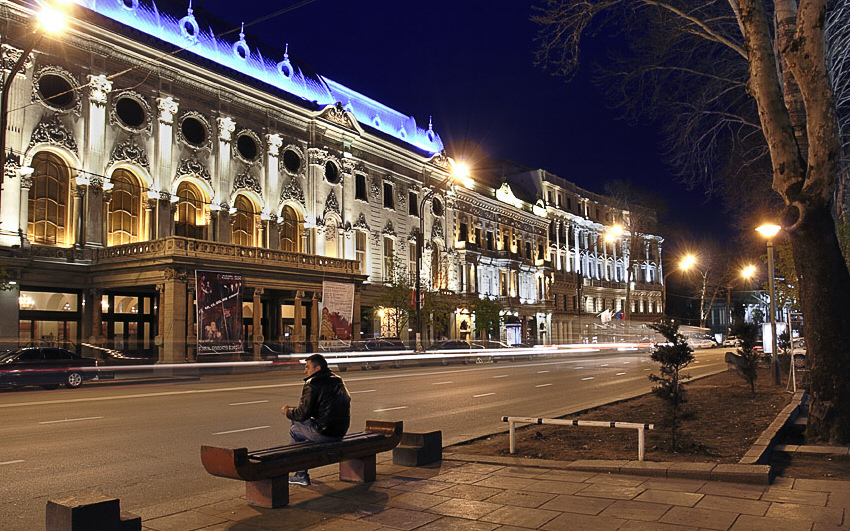 Rustaveli Avenue
Photo: George Kvizhinadze from Tbilisi, Georgia, CC BY-SA 2.0  Jvari Monastery
Photo: Alexxx1979, CC BY-SA 4.0  Anchiskhati Basilica
Photo: Gerd Eichmann, CC BY-SA 4.0  Georgian National Museum
Photo: Jeremy Teigen from USA, CC BY 2.0
Before you go
AI wrote this from well-established facts. Check entry rules and opening hours yourself before the trip.
Good to know
- 1Tradition says King Vakhtang Gorgasali founded the city in the fifth century after his falcon fell into a hot spring. The name Tbilisi comes from a Georgian word meaning warm, after those springs.
- 2The sulphur baths in the old Abanotubani district are still used today, and their brick domes are one of the best-known sights in the old town.
- 3Georgia has one of the oldest winemaking traditions in the world, and many wines are still made in clay vessels called qvevri buried in the ground. Orange wines made from white grapes with their skins are a local speciality.
- 4Georgian has its own alphabet, with rounded letters that look nothing like Latin or Cyrillic script. It is unrelated to Russian, Turkish or Armenian.
- 5Food is built around dishes such as khachapuri, a cheese-filled bread, and khinkali, twisted dumplings filled with meat and broth. A big meal with many shared dishes is called a supra and is led by a toastmaster, the tamada.
- 6The currency is the lari, and the city has long been a meeting point between Europe and Asia, which shows in its mix of Orthodox churches, mosques and a synagogue standing fairly near each other.
Tips for a first visit
- The centre and old town are best done on foot, but the streets are steep in places, so wear shoes with a good grip. The metro is simple to use and covers the main routes, and taxis booked through an app are common.
- Cards are accepted in most restaurants, hotels and shops in the centre, but it helps to carry some local cash for markets, small cafés and minibuses.
- With khinkali, hold the dumpling by its top knot, bite a small hole and drink the broth first. Locals usually leave the knot on the plate.
- Try a Georgian table of several dishes rather than ordering one main course each. Aubergine with walnuts, pkhali and fresh herbs are good things to add.
- If you are invited to a table with toasts, take it slowly. Toasts come often, and it is fine to sip rather than finish each glass.
- Dress modestly when visiting churches: cover shoulders and knees, and women are usually expected to cover their heads with a scarf.
When to go
Spring and autumn are the most comfortable times, with mild days that suit walking, and autumn brings the grape harvest. Summers can be very hot in the city, so many people head for the mountains then. Winters are cold and can be grey, with occasional snow, but the city is quieter and the food feels especially welcome.
From the airport
Tbilisi's main airport, Shota Rustaveli Tbilisi International, lies southeast of the centre, and the trip takes roughly 20 to 40 minutes depending on traffic. Taxis are the simplest option, and there is also a public bus linking the airport with the city, which ends up near the central metro network. From there you can reach the old town by metro or on foot.
More for this trip
- Airport transfer in TbilisiA driver meets you at arrivals, at a price fixed before the ride. Kiwitaxi.
- Things to do in TbilisiTours, museum and show tickets on KKday.
- Car rental in TbilisiCars from local rental firms with full insurance. Localrent.
- Mobile data abroadAn eSIM you set up before take-off that works as soon as you land. Airalo.