
Cities to fly to

Sights
 Mir Castle Complex
Photo: Вадзім Новикаў, CC BY-SA 3.0 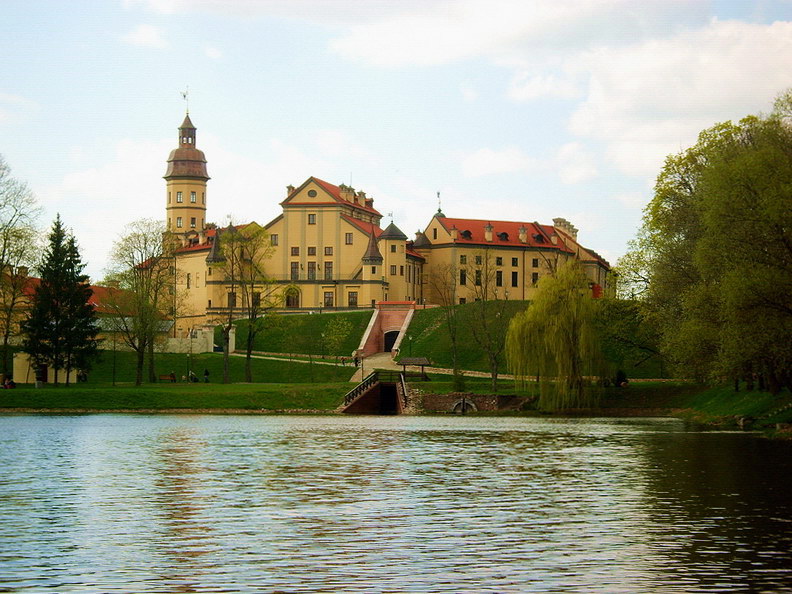 Nesvizh Castle
Photo: Сяргей Кончар (https://fgb.by/viewtopic.php?p=48709&highlight=#48709), CC BY-SA 3.0  Białowieża Forest
Photo: Jacek Karczmarz, CC BY-SA 3.0  Brest Fortress
Photo: Alexxx1979, CC BY-SA 4.0  Belovezhskaya Pushcha National Park
Photo: Szeder László, CC BY-SA 3.0  Trinity Suburb
Photo: Андрэй Дзмiтрыеў (http://fgb.by/viewtopic.php?p=60515#60515), CC BY-SA 3.0  Khatyn massacre
Photo: alarmout, CC BY-SA 3.0  Lida Castle
Photo: alexBel — Мацеша Аляксей (https://fgb.by/viewtopic.php?p=46703#46703), CC BY-SA 3.0
Before you go
AI wrote this from well-established facts. Check entry rules and opening hours yourself before the trip.
Good to know
- 1Two languages are official, Belarusian and Russian, and Russian is the one most people use in daily life. Street signs and transport announcements in the capital are often in both, and in Minsk some also appear in English.
- 2Minsk was almost completely destroyed in the Second World War and rebuilt afterwards, so the centre is dominated by wide avenues and large Stalin-era buildings.
- 3Białowieża Forest, which Belarus shares with Poland, is one of the last remnants of the primeval woodland that once covered much of the European plain. It is the home of the European bison, Europe's heaviest land animal.
- 4Potatoes are at the heart of the national cuisine. The best-known dish is draniki, fried potato pancakes usually served with sour cream, and many other traditional dishes are also built around potatoes.
- 5The Mir Castle Complex and the Nesvizh palace of the Radziwiłł family are both UNESCO World Heritage Sites, and they recall the time when this land was part of the Grand Duchy of Lithuania and later the Polish-Lithuanian Commonwealth.
- 6The currency is the Belarusian ruble, and the country has many lakes, with the Braslav Lakes region in the north a popular place for quiet holidays.
Tips for a first visit
- Learn to read the Cyrillic alphabet before you go, even just enough to recognise station and street names. It makes getting around much easier, since English is not widely spoken outside the main hotels and restaurants.
- Download offline maps and a translation app before arriving, as these will help you in smaller towns where English is rare.
- Try draniki, borscht and machanka, a pork stew eaten with pancakes, and look for local dairy products such as sour cream and curd cheese.
- Carry some cash as a backup, since foreign cards are not always accepted everywhere, and check with your bank before you travel about how your card will work.
- Keep your passport or an ID copy with you, and be polite and low-key with officials and in public. Taking photos of government buildings and military sites is best avoided.
- If you visit someone's home, it is customary to bring a small gift such as flowers or sweets, and to take off your shoes at the door.
When to go
Summer is warm and green, good for lakes, forests and long days in the countryside. Autumn brings colour in the forests and cooler, often rainy weather, while winters are cold and snowy, which suits those who like a quiet, wintry city break. Spring is changeable but fresh, and late spring is a pleasant time for walking.
Getting around
Most travellers move between Belarusian cities by train or by bus, and both link Minsk with the regional centres such as Brest, Grodno, Gomel, Vitebsk and Mogilev. Minibuses, called marshrutkas, serve many smaller towns, and for places like Mir, Nesvizh or the national parks, many visitors hire a car or a driver, since public transport there is less frequent.